
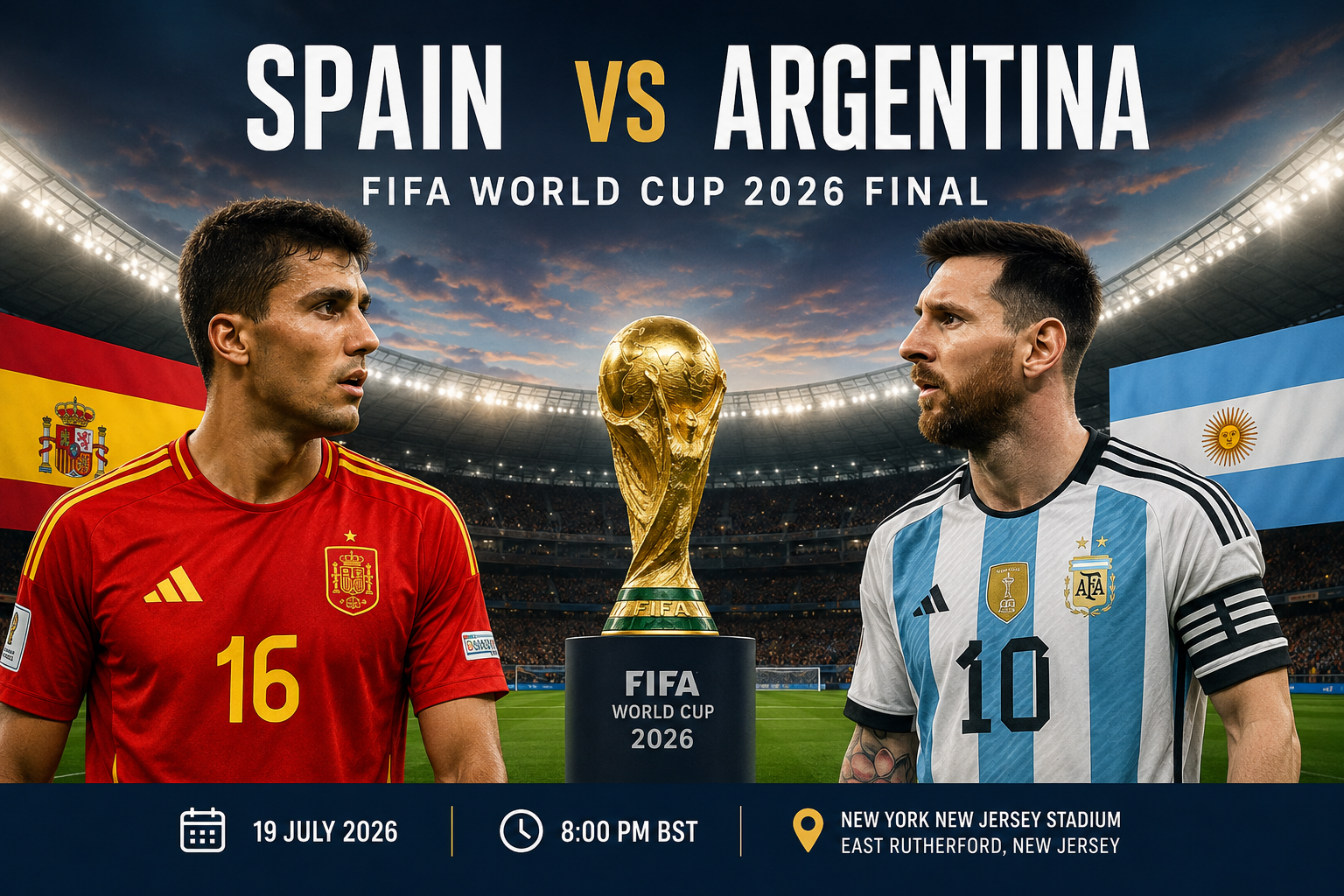
Spain vs Argentina will decide the winner of the FIFA World Cup 2026 in one of the most anticipated international matches of the year. The European champions meet the defending world champions in a final featuring elite players, contrasting tactical approaches and enormous expectations.
The match takes place on Sunday, 19 July 2026, at New York New Jersey Stadium in East Rutherford. Kick-off is scheduled for 8:00 p.m. BST, which is 3:00 p.m. local time in New Jersey.
Spain reached the final by producing a controlled 2–0 semifinal victory over France. Argentina secured its place one day later after coming from behind to defeat England 2–1.
Therefore, the final presents a fascinating contest. Spain will attempt to dominate possession and control the rhythm of the game. Meanwhile, Argentina will rely on experience, resilience and the creativity of Lionel Messi.
This complete Spain vs Argentina World Cup 2026 final preview covers the match details, television channels, team news, predicted lineups, players to watch and tactical battles that could decide the trophy.
For additional football news and tournament coverage, visit the Telego football homepage.
Here are the essential details for the FIFA World Cup 2026 final:
Match: Spain vs Argentina
Competition: FIFA World Cup 2026 Final
Date: Sunday, 19 July 2026
Kick-off: 8:00 p.m. BST
Local time: 3:00 p.m. ET
Venue: New York New Jersey Stadium
Location: East Rutherford, New Jersey, United States
The official FIFA World Cup match schedule confirms that Match 104, the tournament final, will be played at New York New Jersey Stadium on 19 July.
The venue provides a fitting location for the final of the first 48-team World Cup. A capacity crowd is expected, while millions of viewers will follow the match across television and streaming platforms worldwide.
Spain has produced one of the most composed campaigns of the tournament. The team’s ability to control possession, recover the ball quickly and remain organized defensively has made it extremely difficult to defeat.
Spain started the knockout stage with a convincing 3–0 victory over Austria. That performance demonstrated its attacking quality, but later rounds required greater patience.
In the Round of 16, Spain defeated Portugal 1–0 in a close and tactical encounter. It then overcame Belgium 2–1 in the quarterfinals.
The semifinal against France was expected to provide Spain’s most difficult test. However, the Spanish side delivered one of its strongest performances of the tournament and earned a 2–0 victory.
Spain controlled important midfield areas and prevented France from consistently creating clear chances. Goals from Mikel Oyarzabal and Pedro Porro secured Spain’s place in the final. The Royal Spanish Football Federation has also highlighted the team’s disciplined performance and return to a World Cup final. citeturn256910search21turn256910search8
You can find more background on that match in our France vs Spain semifinal preview.
Spain has scored eight goals and conceded only once across its four knockout matches. That defensive record could be one of its biggest advantages in the final.
Argentina’s route has been more dramatic. Nevertheless, the defending champions have repeatedly demonstrated their ability to respond during difficult moments.
Argentina opened the knockout phase with a 3–2 victory over Cape Verde. It then recorded another 3–2 win against Egypt in the Round of 16.
The quarterfinal brought a more convincing result as Argentina defeated Switzerland 3–1. However, the semifinal against England required a late comeback.
England took the lead in the second half through Anthony Gordon and appeared to be moving toward the final. Argentina continued to apply pressure and eventually equalized through Enzo Fernández in the 85th minute.
Lautaro Martínez then scored during stoppage time after receiving a delivery from Lionel Messi. The 2–1 victory sent Argentina into another World Cup final and maintained its opportunity to defend the title. citeturn254532news46
Read our complete England vs Argentina match analysis for more details about the semifinal.
Supporters can also follow official team updates through the Argentine Football Association.
Argentina has scored eleven goals during the knockout rounds. However, it has also conceded six, suggesting that Spain could find opportunities if it attacks with speed and precision.
The World Cup final brings together two teams with contrasting approaches.
Spain generally wants to control possession and dictate the speed of the match. Its players use short passes, positional rotations and intelligent movement to create spaces between defensive lines.
Argentina can also retain possession, but its attack is often more direct. The defending champions are comfortable allowing opponents to have the ball before accelerating forward when space becomes available.
This difference could define the match.
Spain may dominate possession, particularly during the first half. However, Argentina does not need long periods of control to create decisive chances.
Lionel Messi can change the game with one pass, while Lautaro Martínez and Julián Álvarez offer dangerous movement around the penalty area.
Therefore, Spain must avoid losing possession in vulnerable central positions. At the same time, Argentina must remain disciplined when defending against Spain’s wide players.
Spain received some concern when Lamine Yamal and Pedro Porro trained separately following the semifinal.
However, those individual sessions were reportedly precautionary. Yamal was managing minor bruising and soreness, while Porro was dealing with a hamstring concern that was not considered serious.
Spain expects both players to be available for the final, although their condition will continue to be assessed before the starting lineup is confirmed. citeturn254532news41
Luis de la Fuente must also decide whether to maintain the same attacking structure that performed effectively against France.
Mikel Oyarzabal offers intelligent movement through the middle, while Lamine Yamal provides creativity from the right. Dani Olmo and Fabián Ruiz can support attacks from midfield.
The Spanish coach is unlikely to make major changes unless a late fitness issue emerges.
Argentina’s main fitness concern involves Facundo Medina. The defender has been dealing with a calf problem and has not featured since the Round of 32.
Nicolás Tagliafico has continued at left-back and is likely to retain his place if Medina is not ready to return. citeturn254532search39
Argentina must also decide whether to begin with Julián Álvarez or Lautaro Martínez alongside Lionel Messi.
Lautaro scored the winning goal against England after entering as a substitute. However, Julián Álvarez provides intense pressing and intelligent movement without the ball.
Lionel Scaloni could maintain the structure used in the semifinal and keep Lautaro as a high-impact option from the bench.
The following lineups are predictions based on recent selections, tactical roles and available team news. They are not officially confirmed and may change before kick-off.
Formation: 4-3-3
Goalkeeper: Unai Simón
Defenders: Pedro Porro, Pau Cubarsí, Aymeric Laporte, Marc Cucurella
Midfielders: Rodri, Fabián Ruiz, Dani Olmo
Forwards: Lamine Yamal, Mikel Oyarzabal, Álex Baena
Unai Simón should continue in goal behind a defensive line featuring Porro, Cubarsí, Laporte and Cucurella.
Rodri will be vital at the base of midfield. His ability to receive the ball under pressure and protect the defense gives Spain greater control.
Fabián Ruiz and Dani Olmo should operate ahead of him, although Olmo may move into more advanced areas when Spain attacks.
Lamine Yamal will provide width and creativity from the right. Oyarzabal is expected to lead the attack, while Álex Baena could start from the left. citeturn254532search21
Formation: 4-4-2
Goalkeeper: Emiliano Martínez
Defenders: Nahuel Molina, Cristian Romero, Lisandro Martínez, Nicolás Tagliafico
Midfielders: Leandro Paredes, Enzo Fernández, Alexis Mac Allister, Giuliano Simeone
Forwards: Lionel Messi, Julián Álvarez
Emiliano Martínez should start in goal and provide experience in another major international final.
Cristian Romero and Lisandro Martínez are expected to form the central defensive partnership. Nahuel Molina should operate on the right, with Tagliafico likely to continue on the left.
In midfield, Enzo Fernández and Alexis Mac Allister will be responsible for progressing the ball and supporting attacks. Leandro Paredes offers control and defensive positioning.
Giuliano Simeone could provide work rate from a wider role, while Messi and Álvarez lead the attack.
Lautaro Martínez remains a serious starting option after scoring the semifinal winner. However, he may again be used from the bench if Scaloni prioritizes Álvarez’s pressing. citeturn254532search21
Several world-class players could decide the final.
Lamine Yamal will be one of Spain’s most important attacking players.
His ability to receive the ball near the touchline, beat defenders and move inside creates constant uncertainty for opponents. Argentina may use additional midfield support to prevent him from facing Tagliafico in isolated one-on-one situations.
If Yamal is fully fit, he could become Spain’s main source of creativity.
Lionel Messi remains central to Argentina’s attacking play.
At 39, he may no longer cover the same amount of ground as earlier in his career. However, his movement, vision and decision-making remain exceptional.
Messi created the winning goal against England and will look for spaces behind Spain’s midfield.
Spain must track him without destroying its defensive shape. Assigning only one player to follow him could open spaces elsewhere.
Rodri could be the most influential midfielder on the pitch.
He controls the rhythm of Spain’s possession and protects the central defenders when the team loses the ball. His positioning will be essential when Argentina attempts to counterattack.
Rodri must also avoid giving Messi time in the space between midfield and defense.
Enzo Fernández enters the final with confidence after scoring Argentina’s equalizer against England.
He offers passing range, energy and the ability to arrive near the penalty area. His duel with Spain’s midfield could determine whether Argentina can play through the Spanish press.
World Cup finals often produce decisive moments for goalkeepers.
Emiliano Martínez has already shown his ability to perform under pressure. If the match reaches extra time or penalties, his presence could provide Argentina with an important psychological advantage.
The final contains several matchups that could influence the result.
Spain will likely attempt to isolate Yamal against Argentina’s left-back.
Tagliafico is experienced and aggressive, but Yamal’s acceleration and close control could cause problems. Argentina may ask a midfielder to move across and provide support.
However, that support could create extra space for Dani Olmo or Pedro Porro.
Rodri’s positioning will be central to Spain’s plan.
Messi often moves away from the forward line and receives the ball between defensive units. If Rodri follows him too closely, Argentina could exploit the space left behind.
If Rodri remains too deep, Messi may receive the ball with enough time to create chances.
Finding the right balance will be essential.
Spain will attempt to recover possession quickly after losing the ball.
Argentina’s defenders must remain composed when playing through pressure. Lisandro Martínez is comfortable passing from the back, while Enzo Fernández can drop deeper to provide another option.
A mistake during the build-up could immediately create a scoring chance for Spain.
Argentina may accept periods without possession and wait for Spain to commit players forward.
Álvarez can attack spaces behind the defense, while Messi can release runners with accurate passes.
Spain’s full-backs must therefore choose their attacking moments carefully.
Meetings between these teams are relatively uncommon compared with many international rivalries.
However, the final carries additional significance because it brings together the reigning European and South American champions.
Spain won the UEFA European Championship in 2024, while Argentina entered the tournament as the reigning world and South American champion.
The two countries also met in the 2026 Finalissima earlier in the year, adding familiarity to a matchup that already contains several connections between players from Europe’s leading leagues.
Nevertheless, a World Cup final creates a completely different level of pressure. Previous records may offer context, but they are unlikely to determine the result.
UK viewers can watch the World Cup final live on free-to-air television.
The match is scheduled to be shown on:
Coverage is expected to begin before the 8:00 p.m. BST kick-off. Both broadcasters are showing the final in the UK. citeturn254532search12turn254532search5
Viewers should check the official BBC Sport and ITV football coverage closer to kick-off for final programming details.
Availability outside the UK varies by country. Supporters should consult the official FIFA fixtures and viewing information or their local licensed broadcaster.
Spain’s path to victory depends on controlling the midfield while avoiding unnecessary risks.
If Spain maintains possession and moves Argentina’s defensive structure from side to side, openings should eventually appear.
The Spanish side must also continue its excellent defensive work. Conceding only one goal across four knockout matches suggests that Spain can limit even strong opponents.
However, the final will require complete concentration.
Argentina has repeatedly demonstrated that it can score late. Spain cannot assume the match is under control simply because it has more possession or enters the final minutes with a narrow lead.
Argentina must remain compact and prevent Spain from creating central overloads.
Allowing Spain unlimited time in midfield would make the final extremely difficult. Therefore, Argentina may alternate between a medium defensive block and short periods of aggressive pressing.
Messi’s positioning will be crucial during transitions. Once Argentina regains possession, the first pass must reach either Messi or one of the midfielders capable of advancing the ball.
Set pieces could also provide an important opportunity. Romero, Lisandro Martínez and Lautaro Martínez offer a physical threat inside the penalty area.
Finally, Argentina must be clinical. Spain may not allow many clear chances, so every opportunity will carry additional importance.
This final is extremely difficult to predict.
Spain has been the more controlled defensive team throughout the knockout stage. Its midfield quality and ability to limit opponents make it a slight favourite.
Argentina, however, has greater recent experience of winning high-pressure international finals. The defending champions also have Messi, who can decide a match with one moment of creativity.
The first goal could dramatically alter the contest.
If Spain scores first, it may use possession to force Argentina into taking more risks. If Argentina takes the lead, Spain could face a compact defensive block and dangerous counterattacks.
A close match appears likely, with extra time remaining a realistic possibility.
Prediction: Spain 2–1 Argentina after extra time.
This is an editorial prediction, not a confirmed outcome.
The FIFA World Cup 2026 final takes place on Sunday, 19 July 2026.
Kick-off is scheduled for 8:00 p.m. BST and 3:00 p.m. local time in New Jersey.
The match will be played at New York New Jersey Stadium in East Rutherford, New Jersey.
In the UK, the final will be shown on BBC One and ITV1. Online coverage will be available through BBC iPlayer and ITVX.
No. The lineups in this article are predictions based on recent selections and available team news. Official starting teams are normally announced shortly before kick-off.
Spain expects Yamal to be available. He trained separately as a precaution after experiencing minor bruising and soreness, but no major injury was reported.
Yes. Lautaro is a possible starter after scoring the winning goal against England. However, Julián Álvarez may retain his place because of his pressing and movement.
Spain may enter as a narrow favourite because of its defensive record and midfield control. Nevertheless, Argentina’s experience and attacking quality make the final difficult to call.
Yes. Spain won its first FIFA World Cup in 2010.
Yes. Argentina entered the 2026 tournament as the defending world champion.
Spain vs Argentina promises to be a fitting conclusion to the FIFA World Cup 2026.
Spain has reached the final through control, tactical discipline and an outstanding defensive record. Argentina has relied on attacking quality, resilience and an ability to deliver during decisive moments.
The match could be determined by a single mistake, an individual piece of brilliance or a late tactical change.
Spain will attempt to dominate possession and restrict Messi’s influence. Argentina will look to survive Spain’s pressure before attacking quickly when space becomes available.
Whatever the outcome, the World Cup final brings together two worthy contenders and some of the best footballers of their generation.
Follow the latest match previews and tournament coverage through the Telego football news hub.